Scribbles
Apr 30, 2026
Scribbles
Cornelia Elbrecht AThR, SATh, SEP, ANZACATA, IEATA, IACAET
The first time I came across the use of scribbling in the context of art therapy was through Shirley Riley, when she visited Australia in 1996. She facilitated a three-day long professional development workshop on Family Art Therapy, and I had the additional privilege to show her around Melbourne. Shirley was a Californian psychologist and art therapist and an Honorary Life Member of the American Art Therapy Association. She died in 2004, but her legacy still resonates with many. Several exercises we teach during the first module of the Initiatic Art Therapy training are inspired by her.
Shirley Riley worked with client groups who were hard to engage; many were involuntary clients who had never learnt to talk about personal problems, and they certainly did not want to make art. Quite a few where families with court orders to see a therapist, because one member had come in serious conflict with the law. She referred to these families as social constructs, because in many instances the traditional family structure had broken down. She enquired how clients had “constructed their knowledge of social phenomena, developed their language, created an attitude toward gender-sensitive issues and taught each other what to believe in.” (Riley 1993, Vol 20, Issue 3) For her, art products were the avenue to meta-messages about the invented reality of the family.
Shirley Riley’s exercises were usually short, precise and aimed at reaching clients who were not used to sharing personal vulnerabilities. The art making she encouraged was about finding an expression for the “the invented reality” of individuals and the context they lived in.
In a support group for parents of troubled teenagers, she invited participants to draw, on an A4 sheet of paper, what had upset them the most about their child over the past week. Through their choice of colour and movement they could express this using a crayon. Within the allocated two minutes everyone held up a sheet of paper and these strangers discovered that the majority had drawn the “mess in my teen’s room”. Instantly they had something in common to talk about.
Shirley used the same exercise at a feminist conference where she asked every participant to use lines, colour and shape to express on paper “the most humiliating moment I experienced with a man.” She then had 500 women walk around holding up their drawing encouraged to find someone with similar colours and shapes to share their story.
I have frequently used another scribble exercise we called Chasie. Here client and therapist each hold a crayon and have a large (A2) sheet of paper between them. One begins moving around the paper and the other must simultaneously follow as best as possible repeating every curve, twirl, corner or jump. At an agreed sound (such as snap, blip or else) the roles are reversed. The exercise becomes a drawn dialogue. One talks, the other listens. One moves, the other follows. Then the other moves and one must follow.
This exercise is fun. It is important to follow instantly, not to wait until one is finished, but to engage in walking together - whatever crazy marks are made. If my client wants to sit in a corner of the paper and not move, I sit with her there and do not move until it is my turn to lead.
When I am working with hyperactive, dysregulated children, I meet them in their erratic movements until it is my turn to lead. I can then use this option to downregulate them through moving slower, or through introducing rhythmic repetitive movement patterns as they are used in Guided Drawing. (Elbrecht 2018) Effective therapeutic interventions are possible in this non-verbal drawing dialogue.
A colleague of mine worked in a youth detention centre and the young people queued up at her door to get time with her for a Chasie. They did not want therapy, which made them too vulnerable in the tough environment they were in, but they craved the contact through the Chasie. Here they could tell their story without words and feel heard.
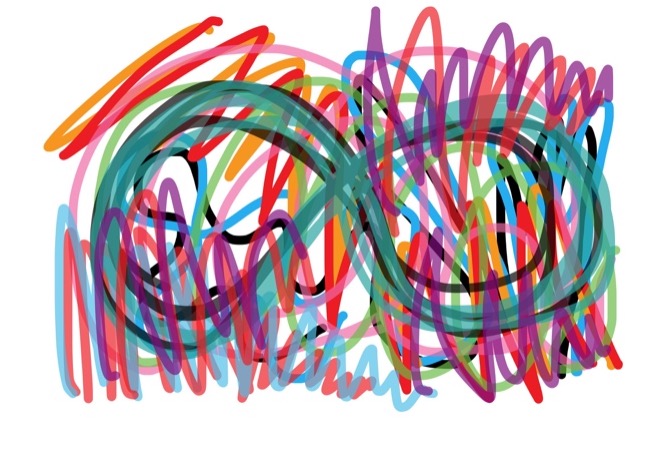 |
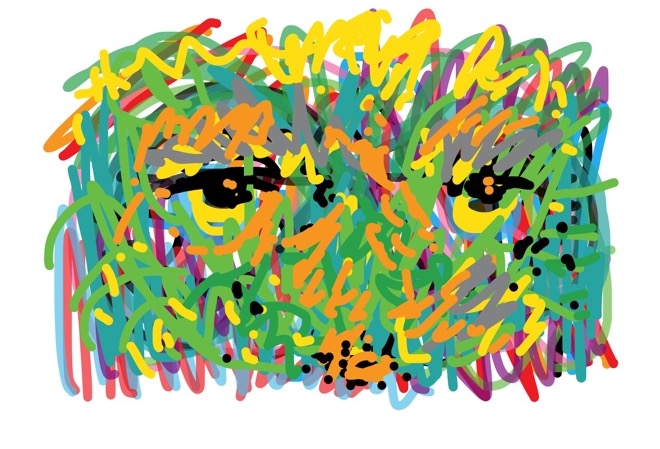
Further engagement may involve the suggestion for the client to highlight any images that appear for them in the scribbles, and then to give the picture a name. It becomes an easy pathway to introduce art therapy through action rather than through explanations. |
|
Figure 1 and 2: A squiggle drawing where the previous Chasie image is turned into a “tiger hidden in the jungle”, which can lead to questions what the tiger might be up to, or need. |
 |
These are simple exercises that engage clients without the fear of having to be good at art or talking about their problems. It also explains without words that in therapy sometimes the client leads and the therapist responds, and sometimes it is the other way around. Therapy is not a relationship of top-down authority, but one of communication and collaboration. For many clients, understanding this distinction is important.
Years ago, when I worked predominantly with children, the Chasie exercise was my session opening ritual. In an instant, the movements on the paper gave me information about the ability of children to follow, to take in information from someone else, but also to be able to lead and state what they want. I could use the exercise to encourage a child to be more daring, or to role model slowing down a highly activated one. I would usually use this exercise as a diagnostic tool. While we were drawing together, I would decide what art materials and explorations to suggest next in this session to best support my clients where they felt stuck.
Works Cited
Elbrecht, Cornelia. 2018. Healing trauma with guided drawing; a sensorimotor art therapy approach to bilateral body mapping. Berkeley, CA: North Atlantic Books.
Riley, Shirley. 1993, Vol 20, Issue 3. "Illustrating the family story: Art therapy, a lens for viewing the family reality." The Arts in Psychootherapy 253 - 264.


