Individual and Collective Trauma in Clay Field Therapy
Mar 20, 2026
Individual and Collective Trauma in Clay Field Therapy
A Clinical Concept Paper by Yuhana Nashmi
Email: [email protected]
1. Introduction
Clay Field Therapy is a sensorimotor art therapy approach that engages the client through touch, movement and three-dimensional haptic exploration rather than visual image-making. It is grounded in the understanding that traumatic experience is encoded not only in narrative memory but also in the body’s postures, gestures, and action tendencies.
Within this modality, the therapist can observe how both individual and collective trauma manifest through the organisation of the hands in the clay, the structuring of space, and patterns of contact, avoidance, tension and collapse.
2. Individual Trauma
Individual trauma refers to exposure to events that overwhelm the person’s capacity to cope, such as interpersonal violence, abuse, accidents, disasters, or sudden loss. These experiences are associated with dysregulation of arousal, changes in perception of safety, and disruptions to the sense of self and agency.
Somatic and sensorimotor approaches emphasise that trauma is often expressed through the body: posture, muscle tone, gestures, and incomplete or inhibited defensive actions. Clay Field Therapy makes these patterns visible and workable in a structured, contained field of touch and action.
2.1 Individual Trauma in the Clay Field: Organisational Themes
In Clay Field Therapy, individual trauma may appear through:
- Disrupted boundaries – difficulty defining, protecting or feeling the edges of the field or forms.
- Fragmented organisation – scattered, disconnected pieces of clay, lack of coherent structure.
- Stop–start movements – interrupted or abandoned actions, difficulty completing sequences.
- Hesitant contact – delayed or minimal engagement with the clay.
- Hyperactivation or collapse – either intense forceful engagement or passive, collapsed hands.
These observations are consistent with trauma-related patterns of hyperarousal, hypoarousal and disrupted self–other boundaries described in the wider trauma and somatic psychotherapy literature.
2.2 Individual Trauma – Haptic Expressions (Clinical Indicators)
Common haptic indicators of individual trauma in the clay field may include:
- Hesitant or minimal touch – fingers barely contacting the clay, skimming rather than engaging.
- Over-controlling or rigid shaping – tight, narrow movements; insistence on control rather than exploration.
- Asymmetry between the hands – one hand active while the other remains frozen or disengaged.
- Excessive pressure or avoidance of pressure – either grinding forcefully into the clay or barely touching it.
- Repetitive smoothing or erasing – repeated flattening, wiping away or ‘undoing’ what has just been formed.
These patterns can be understood as somatic metaphors for survival strategies (fight, flight, freeze, appease) and attempts at regulation or erasure of overwhelming experience.

3. Collective Trauma
Collective trauma refers to the psychological and social impact of traumatic events that affect an entire group, community, or culture, such as war, genocide, persecution, forced displacement, colonisation, or large-scale disasters.
Sociological and psychological literature describes collective trauma as a “blow to the basic tissue of social life” that damages social bonds, shared meanings, and a community’s sense of continuity and belonging. These experiences often shape narratives of identity, land, ancestry, and communal memory across generations.
3.1 Collective Trauma in the Clay Field: Organisational Themes
In the Clay Field, collective trauma may be reflected not only in the individual’s personal story, but also in ancestral, cultural and communal patterns, such as:
- Gestures and formations that echo cultural or ancestral symbols.
- Recurrent themes of land, boundaries, borders and home.
- Movements that suggest displacement, fragmentation or rebuilding.
- Strong need to guard or protect parts of the field.
- Sensitivity to ‘invasion’ or encroachment, even in non-verbal group settings.
These phenomena resonate with research on cultural, historical and collective trauma, which emphasises altered perceptions of belonging, safety in the social world, and continuity with past and future generations.
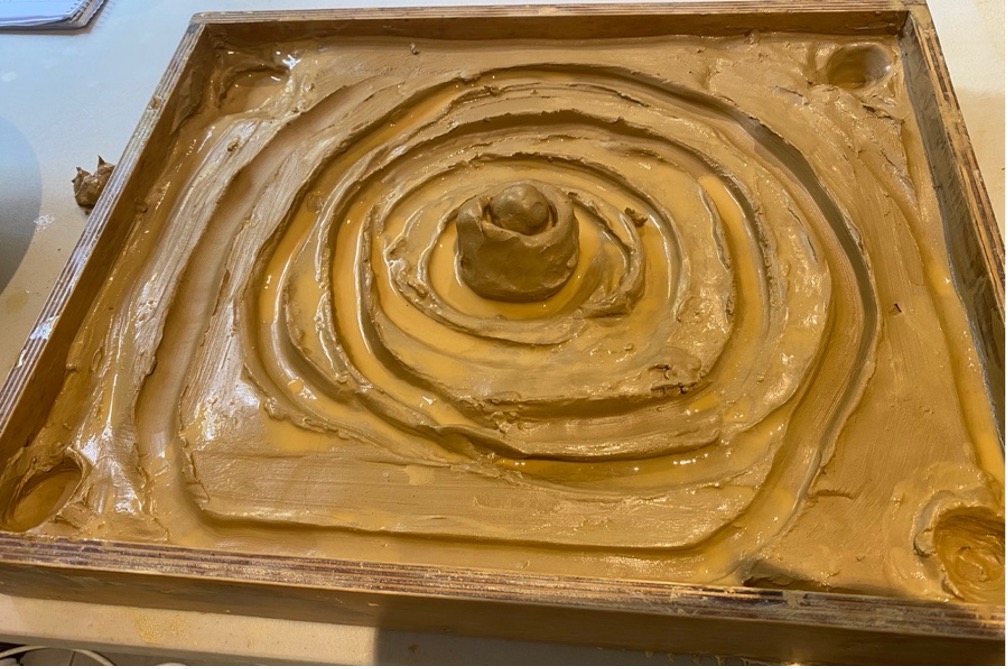
The Clay Field is often experienced not simply as a therapeutic medium, but as land, home, country, or ancestral ground — a space that is frequently charged with fear. For many clients, this terrain does not feel safe to touch. Digging into the clay may symbolically represent disturbing what has been buried for survival, and what lies beneath the surface can be too painful or terrifying to bring into awareness.
As a result, many clients engage only with the surface of the clay, using light scratching or small pinching movements to shape the upper layer while leaving the deeper ground untouched. This form of engagement reflects a protective, embodied response rather than avoidance or resistance. Encouraging such clients to go deeper prematurely can be akin to asking someone to walk through a minefield, where even a small movement risks overwhelming the nervous system.
Within this context, ritual can serve a purifying and containing function, supporting safety and regulation without requiring excavation. At the same time, it is essential to recognise that healing does not always involve uncovering what has been buried. Some experiences may need to remain untouched, honoured through restraint rather than exposure.
3.2 Collective Trauma – Haptic Expressions (Clinical Indicators)
In clinical observation, possible haptic indicators of collective trauma in Clay Field work include:
- Movements shaped by communal or ancestral gestures – e.g., repetitive motions resembling ritual actions, cultural labour, or shared mourning practices.
- Hands searching for gathering, synchrony and belonging – bringing separate pieces together, seeking contact between forms, mirroring or synchronising movements across both hands.
- Dividing, clearing or rebuilding space – creating borders, walls, thresholds; demolishing and reconstructing; creating “inside” and “outside” zones.
- Themes of land, boundaries and home – flattening or contouring the clay like terrain; building enclosures, dwellings or protected areas.
- Shared rhythm in group work – spontaneous synchronicity or counterpoint between participants’ movements, reflecting implicit group fields and collective regulation.
These patterns echo descriptions of collective and cultural trauma as disturbances in shared identity, collective meaning-making, and relationship to land and place.
4. Key Clinical Distinctions
Conceptually, the distinction between individual and collective trauma in Clay Field Therapy can be framed as follows:
- Individual trauma reorganises the self – questions of “Am I safe?”, “Do I have control?”, “What happened to me?” with emphasis on personal boundaries, agency and bodily integrity. Collective trauma reorganises the we –questions of “Who are we now?”, “What happened to us?” with an emphasis on belonging, identity, land, spirituality and communal memory.
- In clinical practice, both dimensions are often intertwined: an individual’s hands may simultaneously express their personal biography and the transgenerational narratives of their family, culture, or community.
5. Integration in Clay Field Therapy
Clay Field Therapy offers a structured, tactile and action-based setting in which both individual and collective trauma can be approached safely and gradually. As a sensorimotor art therapy, it emphasises:
- Embodied movement and haptic engagement – allowing incomplete defensive or orienting movements to emerge and find adaptive completion.
- Sensory–motor organisation – supporting regulation of arousal through repetitive, rhythmic or graded contact with clay and water.
- Boundary formation and spatial structuring – working directly with borders, distances and zones of safety within the field.
- Relational and collective dimensions – particularly in group Clay Field work, where shared rhythms, parallel processes and co-regulation can address collective wounds and restore a sense of “we”.
These interventions are consistent with phased models of trauma recovery, which prioritise establishing safety and stabilisation, followed by carefully titrated processing, and finally reconnection with self, others and community.
In summary, “the hands express what the body holds”: in Clay Field Therapy, individual and collective trauma become visible and workable through touch, gesture and spatial organisation. This offers a powerful avenue for non-verbal integration, completion and reorganisation of both self and we.
Selected References
Elbrecht, C. (2012). Trauma Healing at the Clay Field: A Sensorimotor Art Therapy Approach. Jessica Kingsley Publishers.
Erikson, K. (as cited in Australian Red Cross, 2016). Psychosocial Strategies for Collective Trauma Events.
Herman, J. L. (1992/1998). Trauma and Recovery. Basic Books.
Hirschberger, G. (2018). Collective trauma and the social construction of meaning. Frontiers in Psychology, 9, 1441.
Levine, P. A. (1997). Waking the tiger: Healing trauma—The innate capacity to transform overwhelming experiences. North Atlantic Books.
Ogden, P., Minton, K., & Pain, C. (2006). Trauma and the Body: A Sensorimotor Approach to Psychotherapy. (See also Sensorimotor Psychotherapy: Interventions for Trauma and Attachment).
Psychology Today. (2020). What is collective trauma?
Van der Kolk, B. (2014). The Body Keeps the Score: Brain, Mind, and Body in the Healing of Trauma. Viking.


