Restoring Balance after Trauma
Feb 27, 2026
Restoring Balance after Trauma
Cornelia Elbrecht AThR, SATh, SEP, ANZACATA, IEATA, IACAET
Feeling upset describes aptly a physiological occurrence in which we leave a comfortably settled down state in the body. When we are upset, we lose our gravitational core. We lose our balance, the ground underneath our feet is shifting and becomes unstable. “Our vestibular-balance system provides the brain with information about motion, head position, and special orientation, crucial for maintaining posture, and coordinated eye-movements. It acts as the body’s internal GPS, helping us to navigate and interact with our environment.” (Lanius 2026) This is how Ruth Lanius describes the sense of balance in her recent lecture at the World Art Therapy conference. When the brainstem engages our survival responses in a panic, we know that the higher brain functions are shut down. Social engagement becomes a luxury when we must run for our life. One of these core higher brain functions is our vestibular system, which becomes increasingly unstable to the extent we dissociate from our body. Trauma and PTSD manifest in the body as imbalance. (Lanius 2026)
Gravitational security works alongside the visual system, which allows us to maintain a stable visual field while we are moving. When the eyes respond to trauma with tunnel vision or a dissociated stare, balance becomes affected.
Occupational therapist Sarah Lloyd considers the vestibular system the ‘foundation of all systems’ requiring the coordination of head, neck, shoulder, girdle and trunk. She describes in her work with foster children how in many their sense of balance never fully developed due to complex trauma, leaving these children in permanent states of disorientation. These children present with an underdeveloped muscle tone, which they tend to overcompensate with either being fearful to move or to move very fast to cover up how imbalanced they feel. (Lloyd 2020)
This imbalance is easily observable when clients sit down in front of a Clay Field. Children and adults need to hold onto the edge of the box or the table to ensure they don’t fall over the moment they attempt to apply pressure onto the clay. Often, we can observe a lack of tone in the hands. When clients try to move the clay, the shoulders rise to the ears, because the muscles necessary to push the clay down or away are disconnected from the rest of the body; the applied pressure cannot be met with a counter pressure arising from the gravitational core, which is necessary, if we want to engage the body to push. You can easily experiment to test this yourself by trying to push the table in front of you away with the base of your hands. If you are embodied, it will instantly engage your gravitational core in your head, neck, shoulder, girdle, trunk, abdomen and from there travel down into your hips, legs and feet. If your body is dissociated, you will just push up your shoulders, your body remains disengaged, and you have little or no effect on your table.
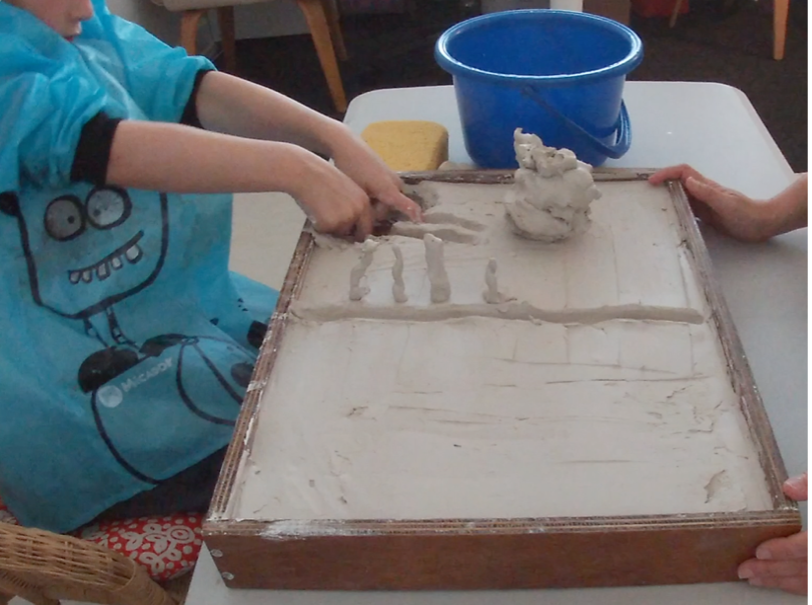 |
Figure 1: This child’s shoulders are pushed high up due to the lack of tone and embodiment when they apply even moderate pressure. The imbalance also becomes visible in the one-sided connection with the Clay Field. (Elbrecht, Healing traumatized children at the clay field; sensorimotor embodiment of developmental milestones. 2021) |
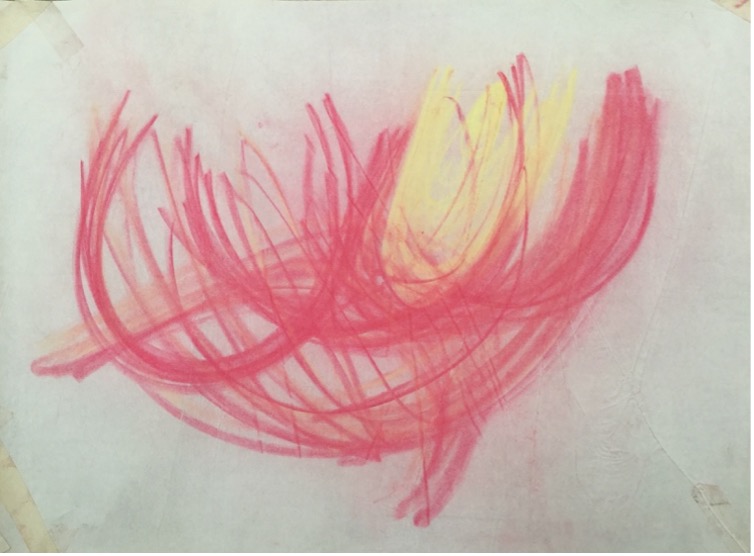 |
Figure 2: If we look at an example from Guided Drawing this bowl shape as a representation of her pelvis was drawn after the client was involved in a car accident. The imbalance and upset are visible in the off-the-ground positioning in space and disorganized floating. |
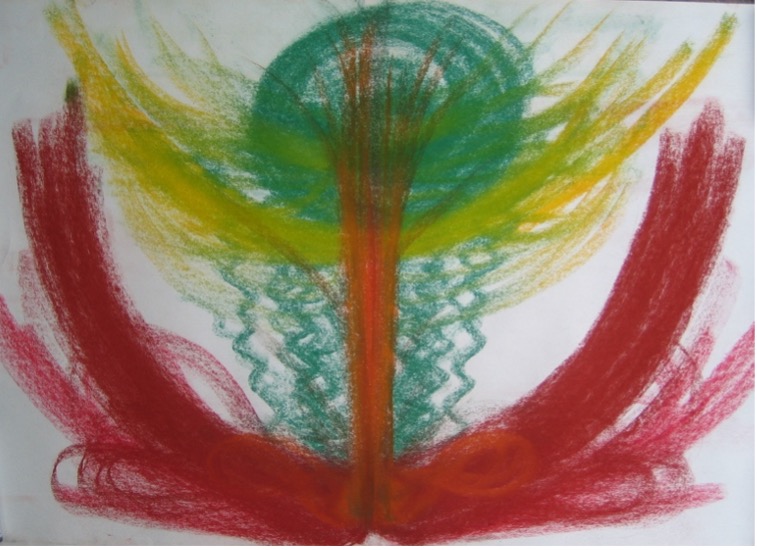 |
Figure 3: At the end of the session this client had settled down, regained visible strength, grounding and coordination of her movements. (Elbrecht, Healing trauma with guided drawing; a sensorimotor art therapy approach to bilateral body mapping 2018) |
“Sensory Motor Approaches do not begin with language and awareness, which may be unavailable in traumatic psychological states. Rather the person is supported to recruit movements with its various sensations as the entry point to healing.” (Lanius 2026)
Van der Kolk describes trauma as the brainstem hijacking the prefrontal cortex. (Van der Kolk 2014) When clients experience a panic attack all the focus is on the fear arousing sensations on the inside. In this state they are unable to think clearly and socially engage. When clients dissociate, they leave their body in parts or fully, which numbs unbearably stressful sensations. These clients are basically not present, their eyes have a vacant stare, their movements are frozen, and they are out of reach.
There are many therapeutic techniques to establish safety, which is the first aid protocol in such cases. However, what needs to follow is engagement of the five senses to facilitate multisensory integration.
As arts therapists we have a spectrum of amazing tools to engage the senses, be this through touching crayons, paints and clay, through music and movement, tasting a cup of tea, smelling essential oils or orienting towards a stabilizing resource. Such interventions rekindle the connection with the external environment.
Clay Field Therapy and Guided Drawing focus on how the body kept the score rather than on retelling the trauma story. This follows more recent insights that trauma therapy is primarily about nervous system regulation rather than fully remembering what happened. The retelling of the trauma story is often too stressful and destabilizing for clients who are not sufficiently resourced, or events happened during the preverbal years in early childhood and have no conscious story attached to them at all.
Restoring balance in adults may depend on when events occurred that left them unbalanced. This could have happened when they were babies, toddlers, teens or adults. A resolution in the Clay Field will mirror the fulfillment of needs depending on the age trauma happened.
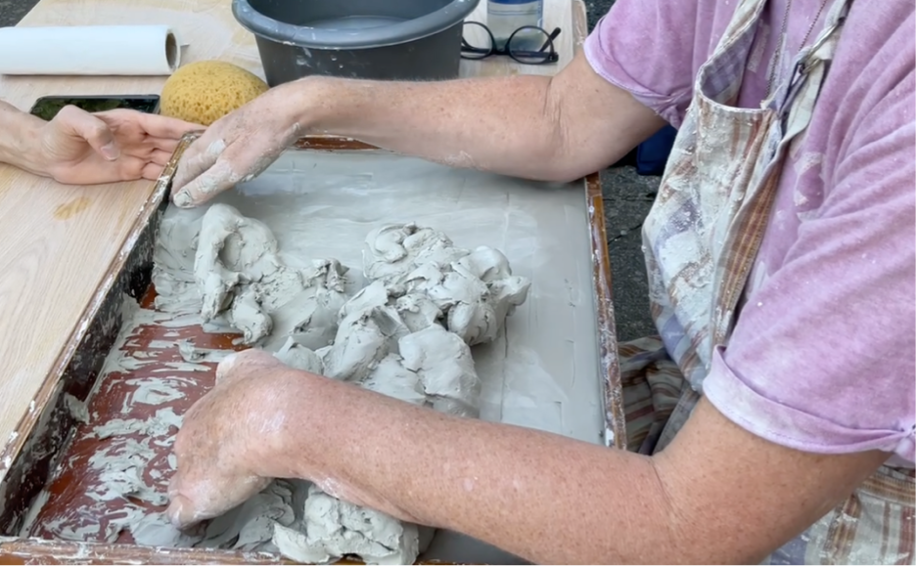 |
Figure 4: This adult client needs to support herself through her underarms leaning onto the edge of the Clay Field to enable her to stay upright. Her hands are collapsed. Adults learn to hide their lack of gravitational security due to trauma and find ways to compensate for their inner instability. |
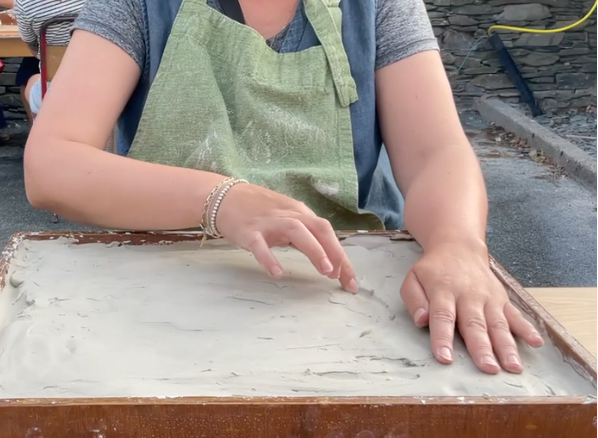 |
Figure 5: The same applies to this client, who needs the left hand to support her balance even when the right applies only light pressure. Her insufficient gravitational security would not allow her to engage both hands simultaneously. |
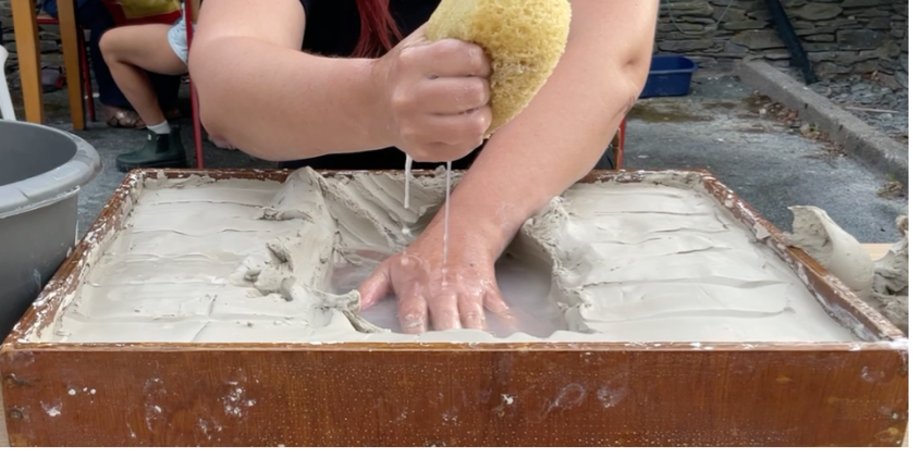 |
Figure 6: At the Clay Field clients often begin spontaneously to post-nurture developmental deficits addressing early childhood needs of loving care. |
Each Guided Drawing or Clay Field session, be this with adults or children, will have its focus on restoring balance in clients. How this unfolds depends on their individual needs, capacity, and what occurred in the past. However, mostly their hands and movements complete and fulfil what did not or could not happen to support them at the time when they were too young, too frightened or too overwhelmed and too collapsed internally. There is a natural drive in all of us to feel safe. Our deepest nature is only interested in healing. Once clients begin to trust the therapeutic setting, they can begin to restore trust in themselves. How this unfolds is often deeply moving and surprising. Once clients have learnt to access safety and know how to downregulate when sensations threaten to become too much, they no longer need controlling interventions from the therapist. Their inner guidance knows the way.
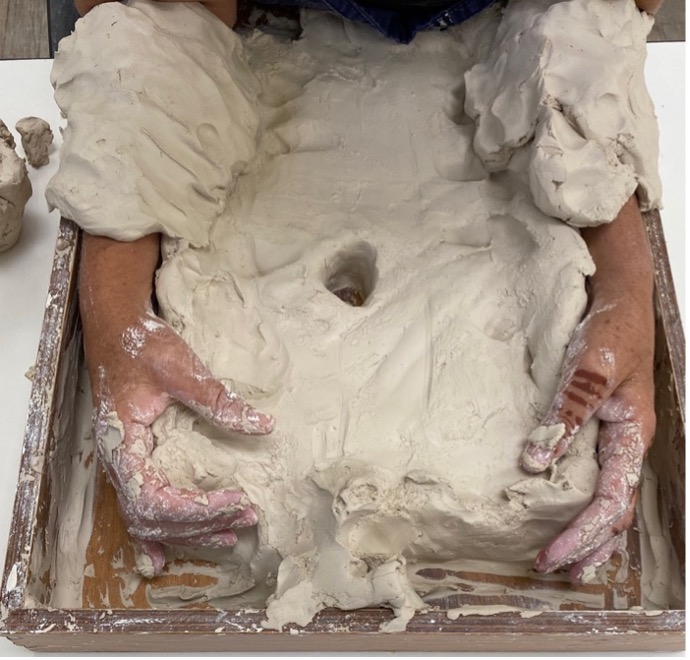 |
Figure 7: Being able to trust an-other-than-me for support would refer to an early childhood need. It is fulfilled here through leaning with the underarms onto the Clay Field being held in clay packed around the arms and holding on to a solid connection. |
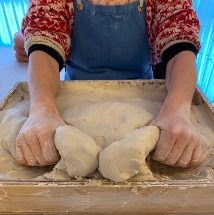 |
Figure 8: Being in charge, able to move the clay, capable to handle the whole field, and grip the created handles with confidence like a steering wheel reflects empowerment. Self-confidence has been restored. This is ego-based self-assurance. |
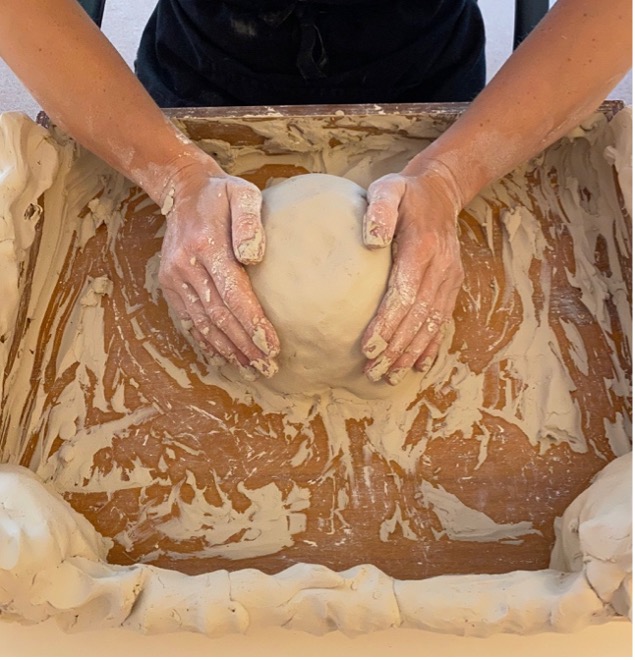 |
Figure 9: This client has claimed her own inner ground in the Clay Field. She has discarded all the clay that is not-me, charged with demands and expectations from others. She trusts herself, firmly stabilized within her own body. Her hands are relaxed and connected, her arms are free and not engaged in holding her up, she is in balance and deeply connected to her own gravitational core. (Elbrecht, Trauma healing at the clay field, a sensorimotor art therapy approach 2013) |
“One of the most basic of all human relationships is our relationship to the gravitational field of the earth. This relationship is even more primal than the mother-child relationship. Sensory integration of the vestibular system gives us “gravitational security” – the trust that we are firmly connected to the earth and will always have a safe place to stand. Gravitational security is the foundation upon which we build our interpersonal relationships.” (Ayres 2015 6th edition)
Works Cited
Ayres, Jean. 2015 6th edition. Sensory Integration and the Child. USA: Western Psychological Services.
Elbrecht, Cornelia. 2018. Healing trauma with guided drawing; a sensorimotor art therapy approach to bilateral body mapping. Berkeley, CA: North Atlantic Books.
—. 2021. Healing traumatized children at the clay field; sensorimotor embodiment of developmental milestones. Berkley CA: North Atlantic Books.
—. 2013. Trauma healing at the clay field, a sensorimotor art therapy approach. London/Philadelphia: jessica Kingsley.
Lanius, Ruth PhD. 2026. Creative Arts Therapies Events. February. https://www.artstherapies.org/stream-conference.
Lloyd, Sarah. 2020. Building sensorimotor systems in children with developmental trauma; a model for practice. London, Philadelphis: Jessica Kingsley.
Van der Kolk, Bessel. 2014. The body keeps the score. New York: Viking, Penguin Group.


