Engaging the Implicit Memory Systems
Sep 28, 2026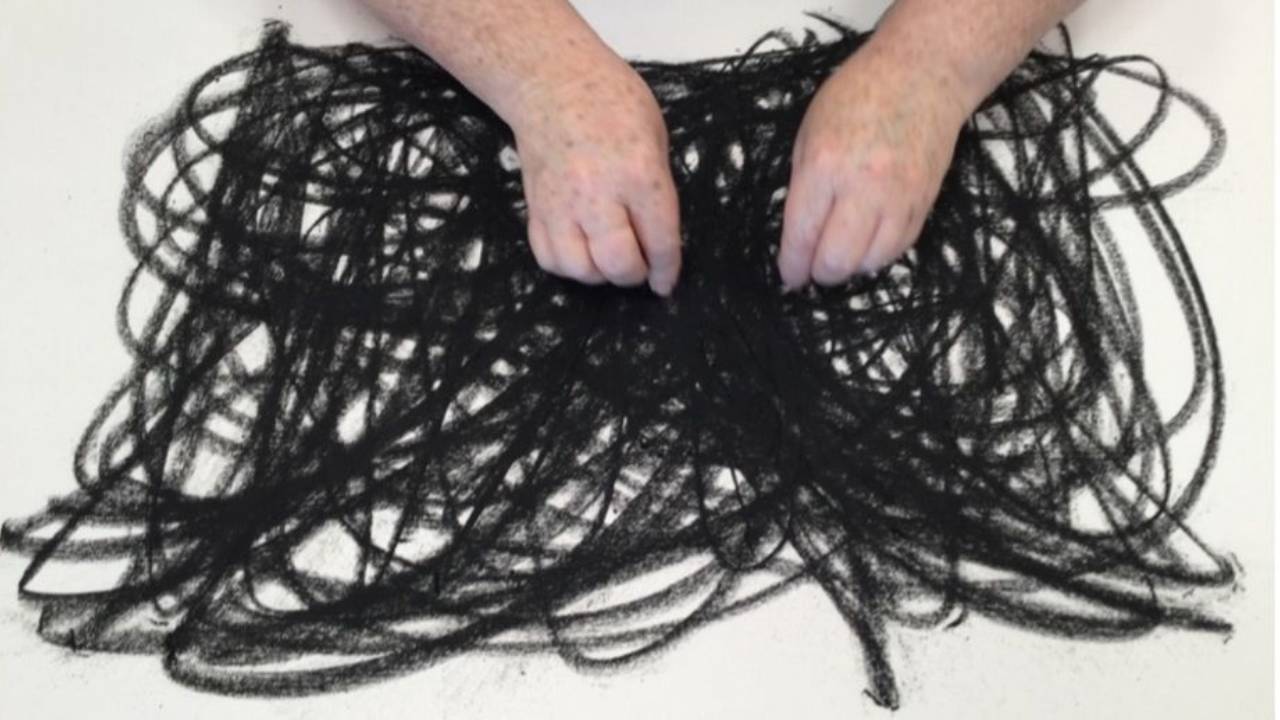
Engaging the Implicit Memory Systems
Cornelia Elbrecht AThR, SATh, SEP, ANZACATA, IEATA, IACAET
When it comes to the so-called top-down approach in psychotherapy and art therapy, I guess every therapist knows how it works. The process involves primarily the explicit memory systems in the prefrontal cortex. It will focus on autobiographical events, aspirations and dreams – and in art therapy on images that are created in association with such events and memories. Occasionally the recall or the insights will trigger emotions, and some therapists will even pay attention to body-posture and movements, but for most of the session the therapy will rely on verbal communication and the cognitive understanding of the process.
However, in recent years the call for a bottom-up approach has become stronger. Neurologists, psychiatrists and trauma specialists such as Peter Levine, Stephen Porges, Bruce Perry, Bessel van der Kolk, Babette Rothschild and others emphasise that complex trauma does not respond well to talking therapies. Complex trauma has its origin in adverse experiences in early childhood, also physical, emotional, sexual and medical trauma. These are events that are held in the implicit memory systems of our body and clients rarely have the words or even the awareness to connect these past events to a current diagnosis of pain, disease or mental illness (Van der Kolk 2014).
For this reason, the bottom-up approach engages the implicit memory systems first. Rather than focussing on autobiographical events, therapies strive to facilitate physiological and emotional safety and prioritize nervous system regulation before engaging with cognitive integration (Porges 2011). In this way developmental needs and non-verbal experiences can be addressed.
Implicit memory encompasses the brainstem and the limbic system. The brainstem is the seat of our ancient survival system. This is the part of our brain that deals with trauma, and it does this in a predominantly body-based way. The brainstem is strongly influenced by attraction and repulsion. It is shaped through repeated action patterns, such as learning to walk, to ride a bike, or to put a spoon into our mouth. Once we have mastered such an action pattern, it becomes part of our implicit body memory, and we generally do not ever think about it again. In the same way we do not think about breathing, how our heart beats or our muscles contract and relax. However, this part of our implicit memory is also shaped by learnt behaviour to avoid pain and abuse, and such remembered patterns remain in place even when the threatening experiences have happened long ago.
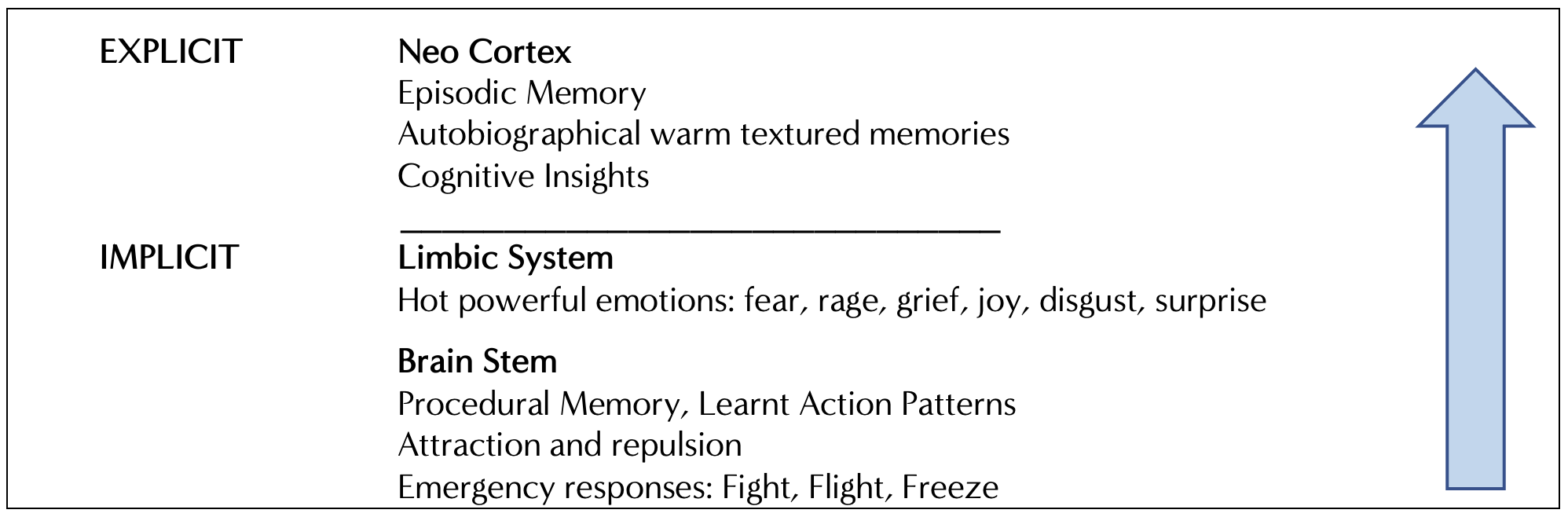
Fig 1: Memory Systems (Levine 2015)
Levine calls the next ‘higher’ limbic system our emotional brain. It is in many ways just as much beyond our conscious control and predominantly body based. Grief, anger, joy, fear, surprise and love can be powerfully compelling. Emotions are primarily physiological events. We can die from a broken heart, be blinded by rage, and fall in love. We may think we are in charge, until something happens which overwhelms us. (Levine 2015)
Only at around the age of six children begin to have sufficient language skills that allow them to talk about a particular event. Yet, we know that the most formative experiences in childhood are likely to happen at a much younger age. (Perry 2009) Also, sexual trauma is primarily non-verbal, and so is the experience of accidents, followed frequently by medical procedures, where the client was anesthetised, and yet, the body remembers. (Rothschild 2000) These memories often don’t have a cohesive story to tell. Rather they may make themselves known as inner tension, restlessness, and sleeplessness, or as having no energy, feeling tired and internally collapsed. Emotional pain that cannot be communicated may manifest as physical pain, as chronic illness or an autoimmune disease – or erupt as rage and grief. (Van der Kolk 2014)
In the context of Sensorimotor Art Therapy Guided Drawing and Clay Field Therapy naturally engage implicit body memories through rhythmic movement patters and through touching the clay. Both have been developed over decades as effective body-focused therapies. (Elbrecht, 2013) (Elbrecht 2021) In addition, the Expressive Therapies Continuum developed by Lusebrink and Hinz gives the art therapy experience a structure that is informed by neurobiology. (Hinz 2020) (Lusebrink 2004)
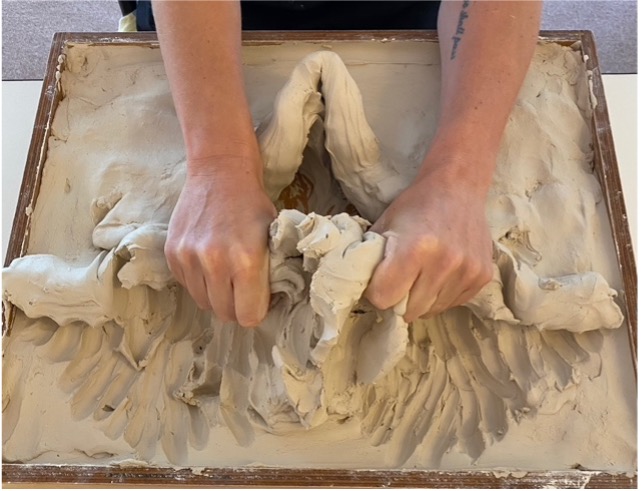
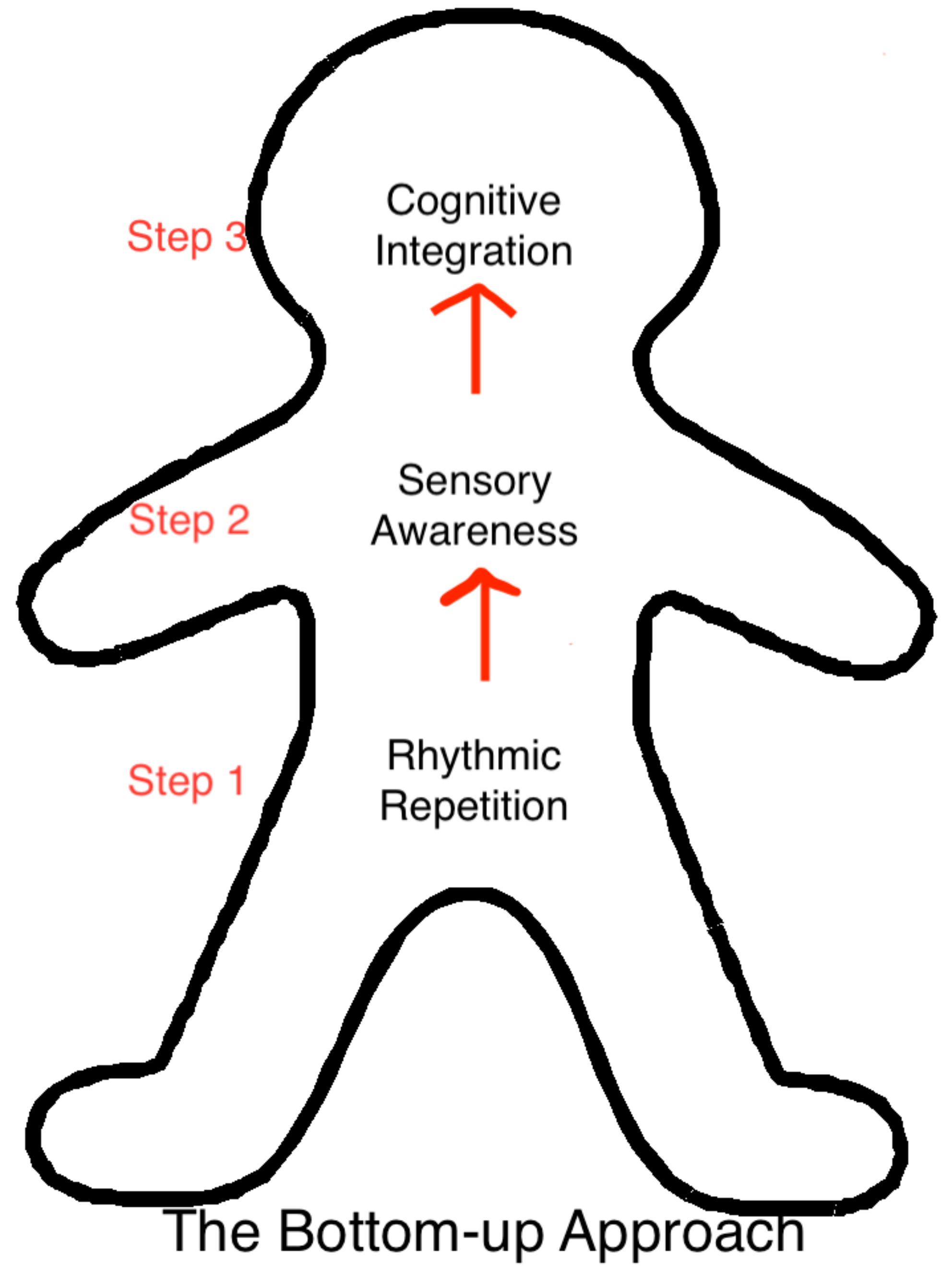
If we look at the bottom-up approach in the context of the Expressive Therapies Continuum, a session begins with the Kinesthetic/Sensory Level. In Guided Drawing the focus at the start is on bilateral, rhythmic repetition of motor impulses informed by the experience of physiological tension and pain. Sensing resonance in the body, will lead to massage movements executed as motor impulses. In Clay Field Therapy undifferentiated motor impulses are expressed through touching the clay, sensing and molding it. Initially the process follows implicit action patterns, patterns we learnt in the first, preverbal years of early childhood. They reflect the way we experienced attachment, how we learnt to touch and being touched in relationships, and how we were taught to handle the world.
 |
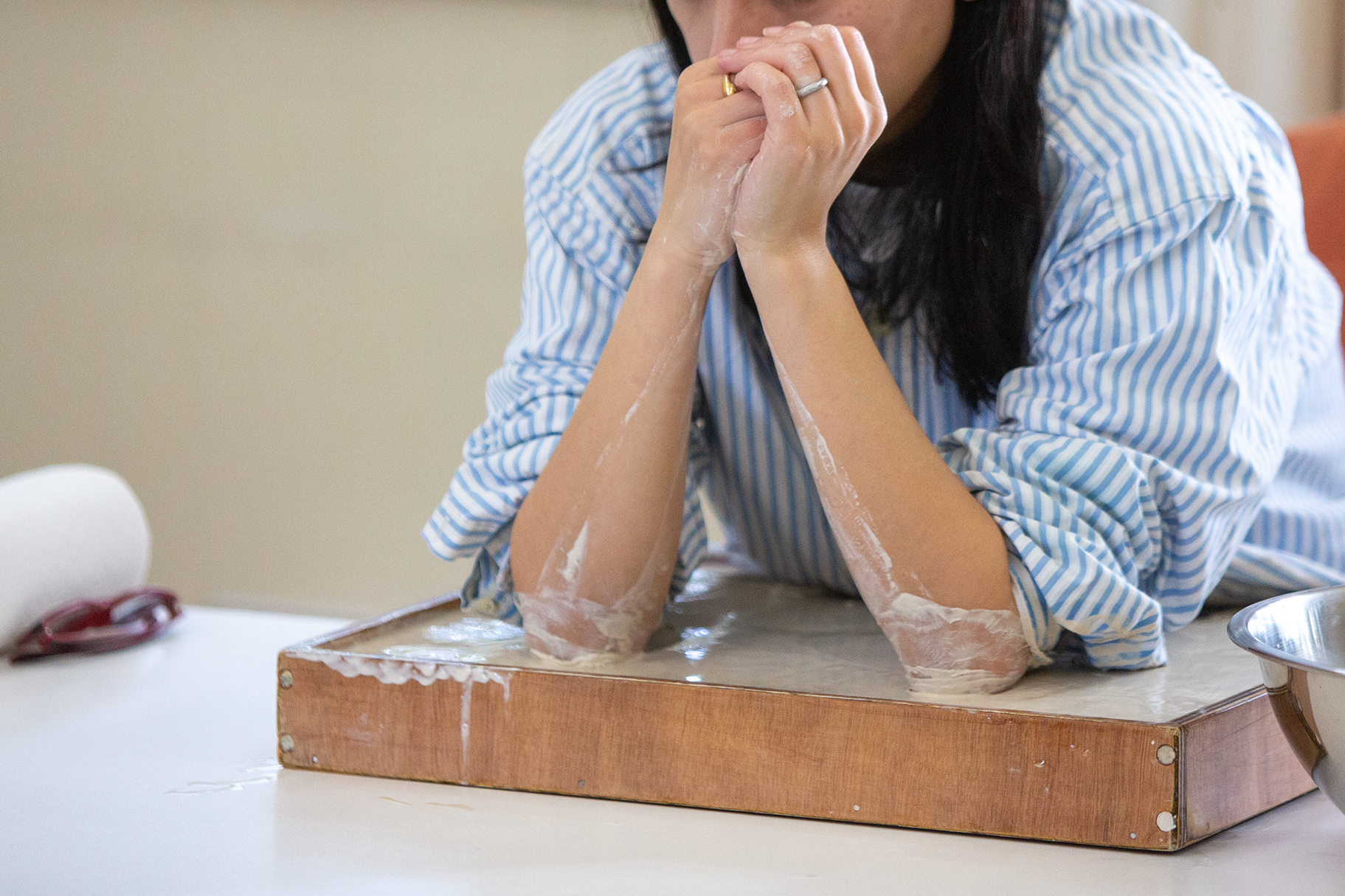 |
Gradually the Perceptual/ Affective Level becomes activated. Now we can direct motor impulses with intent; we can apply archetypal shapes in Guided Drawing to orient and to affect change. As we gain inner orientation, we can create rudimentary landscapes in the Clay Field. The felt sense reveals its encoded emotions and allows us to express affect through colors, shape and movement. This is still a primarily non-figurative and non-verbal process in the context of Sensorimotor Art Therapy. We may splash red color onto the page and scratch it with our finger nails, or strangle a lump of clay in rage. Or, we may tentatively take a hand-full and feel, what it is like “to have lots”.
Until gradually, and often only toward the end of a session the Cognitive/Symbolic Level allows us to link the language of implicit memory to conscious, autobiographic events. Only now the expression of color, shape, movement may reveal its symbolic meaning. We may gain the ability to make sense of the felt sense in the body. Based on experience, we may now look at updating old belief systems.
 |
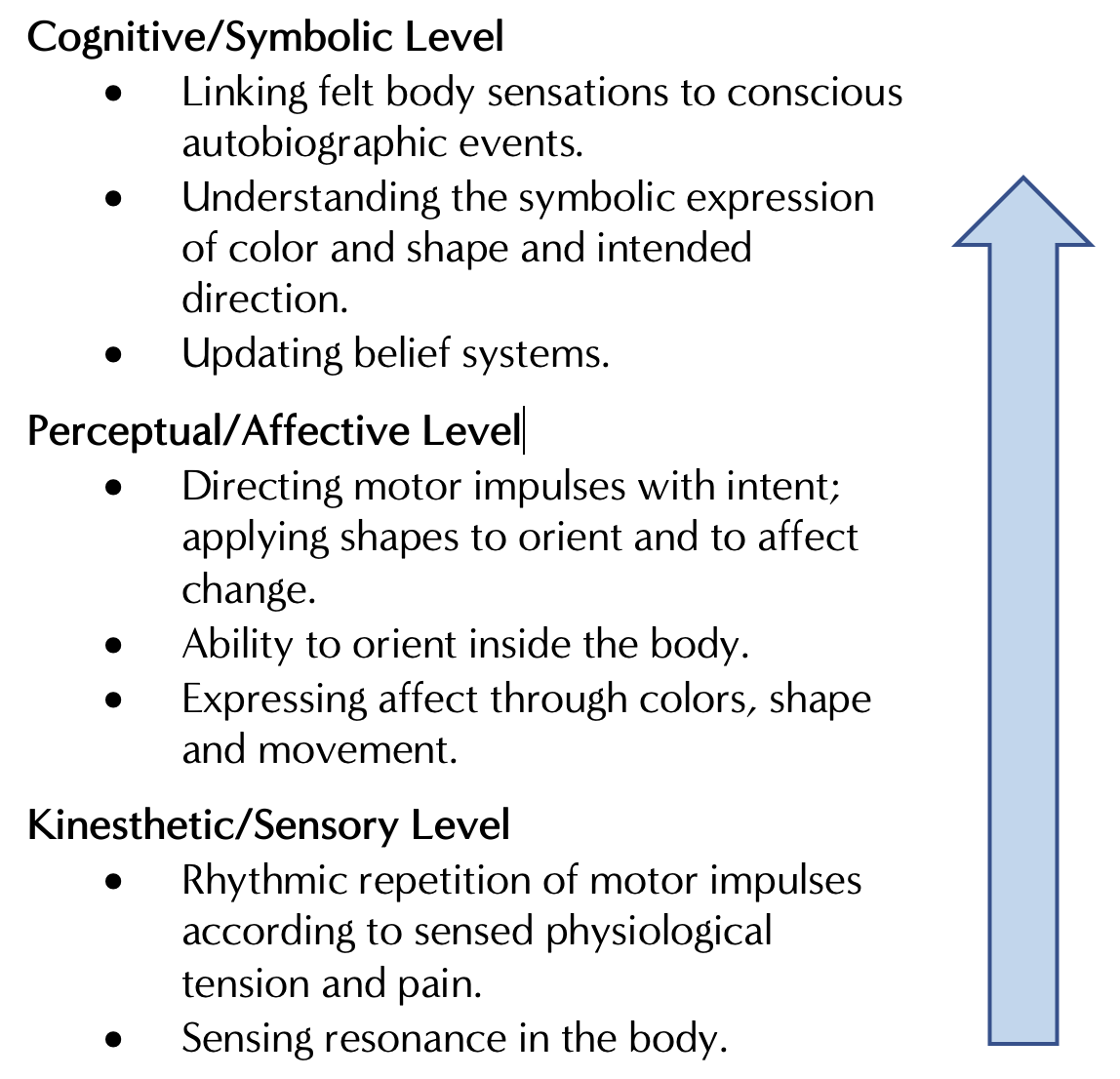 |
| Fig 2: Bottom-Up Approach | Fig 3: Expressive Therapies Continuum |
On the Kinesthetic/Sensory Level the bottom-up approach from the perspective of the client may initially make little sense: "I have no idea what I am doing here, but I keep drawing this shape just as I feel it in my body." Or: “To touch the clay feels strange, disgusting, even scary and yet I want to touch it”. Once it comes to the Perceptual/ Affective Level, this may shift towards: "I notice how this movement resonates in my body. I feel better now." Frequently only at the end of the session clients will gain insight into: "Finally I understand why I have been acting like this." But also, they may now be able to question long-held beliefs about themselves. “I feel powerful” may be the end of identifying as a victim. “I am safe to feel my heart” may facilitate the transition from being in shut-down and denial. These are insights based on a felt sense experience; these have emerged from an embodied inner knowing and not from cognitive insights. Such implicit patterns of being are remembered as a gut-felt knowing of who I am.
Works Cited
Elbrecht, Cornelia. 2021. Healing traumatized children at the clay field; sensorimotor embodiment of developmental milestones. Berkley CA: North Atlantic Books.
—. 2013. Trauma healing at the clay field, a sensorimotor art therapy approach. London/Philadelphia: jessica Kingsley.
Hinz, Lisa. 2020. Expressive Therapies Continuum; a framework for using in art therapy. London: Routledge.
Levine, Peter. 2015. Trauma and memory; brain and body in search of the living past. Berkeley: North Atlantic Books.
Lusebrink, Vija. 2004. "Art therapy and the brain: an attempt to understand the underlying processes of art expressioon in therapy." Art Therapy 125 - 135.
Perry, Bruce. 2009. "Examining Child Maltreatment Through a Neurodevelopmental Lens: Clinical Applications ot the Neurosequential Model of Therapeutics ." Journal of Loss and Trauma 240 - 255.
Porges, Stephen, W. 2011. The Polyvagal Theory: Neurophysiological Foundations of Emotions, Attachment, Communication, and Self-regulation. New York: W. W. Norton Series on Interpersonal Neurobiology.
Rothschild, Babette. 2000. The body remembers. New York: Norton and Company.
Van der Kolk, Bessel. 2014. The body keeps the score. New York: Viking, Penguin Group.


